#3 — How Experience Design Changes Corporate Events
Experience design replaces the question “how should this event look?” with “what should each attendee feel, minute by minute, from arrival to exit?” It treats a corporate event as a designed journey — sequenced emotional beats delivered through light, sound, motion, and space — rather than a stage to be decorated. The shift changes everything downstream: budgets move from ornamentation to engineered moments, and outcomes become measurable instead of cosmetic.
This article explains what experience design actually means, how audience journey mapping works, how sensory design is executed, the patterns that recur in launches and summits, and how to measure whether any of it worked.
What Does Experience Design Mean Beyond Decor?
Decor answers what a venue looks like when attendees walk in; experience design answers what happens to attendees across the entire event. It is a time-based discipline — closer to directing a film than dressing a set. A decorated event is static from the first minute to the last. A designed experience has an arc: arrival, build, peak, resolution.
The practical differences:
- Time replaces space as the primary canvas. Decor is judged in a photograph; experience design is judged across ninety minutes. The design document is a timeline of states — how the room’s light, content, and sound evolve — not a floor plan with finishes.
- Moments replace themes. Decoration expresses a theme uniformly everywhere. Experience design concentrates investment into engineered moments — the reveal, the transition, the finale — because memory forms at peaks, not averages.
- Systems replace props. The tools are programmable: projection mapping, LED content, lighting cues, synchronized audio. A backdrop is printed once; a designed environment changes state on cue, meaning the same room can be five different places during one evening.
- Intent replaces taste. Every element must answer “what should the attendee feel here, and why?” If the answer is “it looks premium,” that is decor logic. If the answer is “this corridor decompresses them before the reveal,” that is design logic.
Many Bangladeshi event producers, including Studio Z BD, are increasingly emphasizing audience experience rather than relying solely on stage decoration — a regional reflection of a global shift that has already reshaped how multinational brands brief their events.
How Do You Map the Audience Journey From Arrival to Exit?
Journey mapping breaks the event into stages — approach, arrival, transition, seating, program, peak, release, exit — and designs each stage’s emotional intent, sensory state, and duration. The map exposes the dead zones (queues, waits, transitions) that decoration ignores and experience design converts into part of the show.
The stages and their design questions:
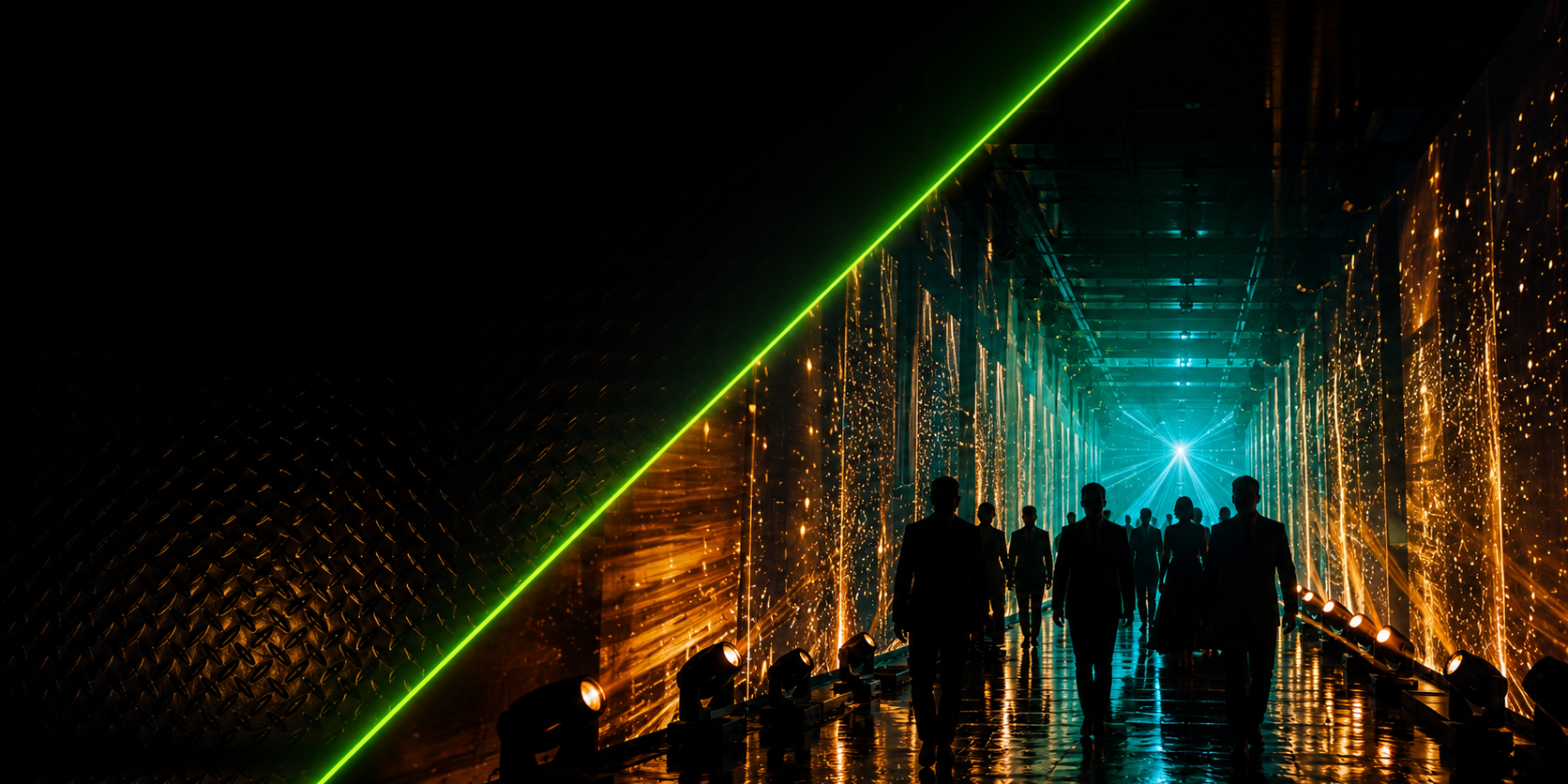
- Approach and arrival. The experience starts in the car park, not at the stage. What do attendees see, hear, and feel in their first sixty seconds? A lit facade, a themed entry sequence, or an LED corridor shifts people out of their workday before they reach registration.
- Registration and holding. Traditionally the worst-designed minutes of any corporate event. Designed well, this becomes the immersion ramp: ambient soundscape, environmental projection, a curiosity object (the concealed product, a countdown element) that starts the narrative early.
- The transition into the room. The threshold moment — moving from lobby to main hall — is a free dramatic beat. Contrast does the work: dimmer, cooler, quieter lobby; then the room opens at full sensory scale.
- Program pacing. Map the run-of-show as an intensity curve. Speeches and dense content sit in the valleys; engineered peaks — the reveal, the film, the performance — sit where attention needs recharging. No segment should be flat for longer than the audience’s realistic attention span.
- The peak. One moment, deliberately engineered, where every system fires together. This is where experience design concentrates its budget.
- Release and exit. After the peak: a designed decompression — experience zones, photo moments, the product available for close inspection — and an exit that ends on intention (a final image, a takeaway) rather than a fire-door shuffle.
The discipline: walk the venue as the attendee, minute by minute, and write down what they experience at each step. Every gap in that walk-through is a design task.
How Does Sensory Design Work — Light, Sound, Motion, and Scent?
Sensory design orchestrates the channels an audience absorbs unconsciously: light sets emotional register, sound carries pacing and cohesion, motion draws attention, and even temperature and scent shape comfort and memory. The craft is coherence — every channel telling the same story at the same moment — because the brain trusts environments where the senses agree.
Channel by channel:
- Light. The fastest emotional lever in the room. Color temperature and hue set register (warm amber for intimacy, cold white for precision, saturated color for spectacle); intensity focuses attention; movement creates energy. Programmable lighting means the room’s mood is a cue stack, not a fixed condition.
- Sound. The connective tissue. A designed event has a continuous audio identity — arrival soundscape, transition stings, underscore beneath key speeches, and full-range impact at peaks. Silence is part of the palette: the two seconds of quiet before a reveal do more than any fanfare.
- Motion. The eye goes where things move. Projected content, kinetic light, and animated LED surfaces direct attention deliberately — toward the stage before a segment, across the room during transitions. Uncontrolled motion (busy loops running during a speech) is attention theft; designed stillness matters as much as designed movement.
- Space and body. Temperature, crowd density, sightlines, and standing-versus-seated states all register emotionally. A room slightly too warm at peak density reads as discomfort no visual can override.
- Scent — used sparingly. The most memory-linked sense, and the least controllable. Subtle, consistent scenting of an entry sequence can anchor an event in memory; heavy-handed use backfires.
Coherence is enforced technically: the channels synchronize through show control, so the light shift, the audio swell, and the content change land as one designed beat. When a projection mapping tribute was staged for the German Embassy in Dhaka on Bangladesh’s Victory Day (youtube.com/watch?v=vt12Buajg_E) — delivered before senior government dignitaries — the impact came precisely from this coherence: imagery, light, and sound moving as a single composed statement rather than parallel decorations.

What Case Study Patterns Recur in Product Launches and Summits?
Two patterns dominate designed corporate events: the launch pattern — a journey engineered toward one reveal peak — and the summit pattern — a multi-session arc where experience design maintains energy and identity across a full day or more. Both replace uniform decoration with sequenced states.
The launch pattern:
- Concealment from arrival. The product or brand is present but hidden — a covered centerpiece, a teasing motif — turning the pre-show into a build.
- A compressed narrative. Twenty to forty minutes of designed program: context, tension, then the synchronized reveal strike (lighting, LED, laser, audio on one cue).
- Immediate access. Post-reveal, attendees move to the product — demo zones, photo moments — converting emotion into engagement while it is hot.
- The whole room as media. Walls, stage, and environment carry one theme from entry to exit; the reveal transforms not just the stage but the room’s entire state.
The summit pattern:
- An identity system, not a backdrop. One visual language across every session, break, and space — so the day feels authored rather than assembled.
- Energy management. Designed transitions between sessions (light and sound resets), sensory contrast between content-heavy and experiential segments, and a produced opening and closing that bookend the day at high intensity.
- Break spaces as designed spaces. Networking zones with intentional light, sound, and interactive elements — because the conversations in breaks are the summit’s actual product.
- A closing peak. Summits that end on a logistics announcement die in memory; summits that end on a produced emotional close get talked about on the way home.
Both patterns share the underlying rule: identify where memory should form, and design backward from those moments.
How Do You Measure the Impact of Experience Design?
Measure experience design against the outcomes it claims to move: unprompted recall of the core message, attendee behavior during and after the event, content generated and shared, and downstream commercial signals — order activity, pipeline, press coverage. The measurement plan is written before the event, with baselines from previous editions where they exist.
The measurement stack:
- Recall testing. Post-event surveys days or weeks later: what do attendees remember unprompted? Which moment do they describe? If the engineered peak is not the answer, the design missed.
- In-event behavior. Dwell time in experience zones, participation rates at interactive elements, when people left. A designed event holds its audience; an endured one empties from the back.
- Capture metrics. Volume of attendee photos and clips, social reach, tagged posts. A designed peak produces a visible spike of phones — countable in the room and traceable online.
- Commercial signals. For dealer events: order commitments in the following 30 days versus prior editions. For launches: coverage volume and message accuracy. For summits: attendance retention year over year.
- The comparison discipline. The strongest evidence is longitudinal — the same annual event before and after the shift from decoration to design, measured identically.
The honest caveat: experience design is one variable among many, and attribution is never laboratory-clean. But the direction of evidence is consistent — events designed as journeys outperform decorated ones on every memory-linked metric, and memory is what corporate events are for.
FAQ
What is the difference between experience design and event design?
Event design typically covers the visual and spatial treatment — staging, decor, branding. Experience design covers the attendee’s entire journey through time: emotional pacing, sensory states, engineered peaks, and transitions from arrival to exit. Event design is one input; experience design is the governing discipline that sequences everything the attendee encounters.
Does experience design cost more than traditional event decoration?
Not necessarily — it allocates differently. Budget concentrates into a few engineered moments and programmable systems (lighting, projection, LED content) instead of spreading across uniform ornamentation. Many designed events cost the same as decorated equivalents; the spend simply moves to where memory forms.
Can experience design work for small corporate events?
Yes. The mechanisms — journey mapping, sensory coherence, one designed peak, intentional transitions — scale down to boardroom size. A fifty-person executive dinner with a single projection-mapped reveal and a designed light-and-sound arc is experience design. Scale affects budget, not the discipline.
How early should experience design start in event planning?
At the beginning — alongside venue selection, not after it. Venue geometry, power, rigging, and light control determine what can be designed; choosing the venue first and designing inside its accidents is the most common sequencing error. Engage the experience and production team before the venue contract is signed.