#4 — Behind Every Great Show: The Role of Technical Direction
Technical direction is the discipline of making every system in a live show — lighting, video, audio, rigging, effects — fire as one. The technical director (TD) owns the master plan that binds those departments to a single timeline, and carries final accountability for the show running on time, in sync, and without failure. When a reveal lands to the exact beat, that is technical direction working.
Audiences never see it. Clients rarely ask about it. But no large show survives without it. This article breaks down what a technical director actually does, how multi-system synchronization works in practice, and why the best technical direction is the kind nobody notices.
What Does a Technical Director Actually Own?
The technical director owns the show’s entire technical architecture: system design, signal flow, cue structure, crew coordination, rehearsal schedule, and contingency planning. Every department — lighting, video, audio, rigging — executes its own craft, but the TD owns how those crafts combine into one synchronized production.
In concrete terms, the TD’s ownership covers:
- System design. Which media servers, consoles, and control protocols the show runs on, and how they interconnect. The TD draws the signal path before a single case is loaded onto a truck.
- The master cue structure. Every show moment mapped against time or trigger: what fires, when, from which system.
- Interdepartmental coordination. Lighting programmers, VJ operators, audio engineers, and riggers each optimize their own domain. The TD forces those domains to serve the same second.
- The rehearsal schedule. Deciding what gets rehearsed, in what order, and how many full runs the production gets before doors.
- Live show calling or supervision. During the show, the TD either calls cues directly or supervises the operators who do — and makes the real-time decisions when something deviates from plan.
The role is distinct from the creative director, who decides what the audience should experience, and from the production manager, who handles crew, trucking, and schedule. The TD converts creative intent into an executable, failure-resistant technical system.
How Does a Technical Director Coordinate Lighting, Video, Audio, and Rigging?
Coordination happens through a shared timeline and a shared control language. The TD locks every department to common references — timecode, cue numbers, or manual calls — so a single moment in the show triggers coordinated action across all systems. Without that shared reference, each department runs its own version of the show.
The mechanics look like this:
- A master show document. Setlist or run-of-show broken into numbered cues, each specifying lighting state, video content, audio playback, and any effects or rigging moves.
- Synchronization method. Timecode (SMPTE or MIDI timecode) for fully automated segments; manual cue calling over comms for segments that follow live performers. Most real shows mix both.
- Control protocols. DMX and Art-Net for lighting, video feeds from media servers to LED processors and projectors, OSC or MIDI triggers between systems. The TD decides which protocol binds which pair of systems.
- A comms structure. Who is on which channel, who calls, who confirms. In a high-cue show, disciplined comms is the difference between tight and sloppy.
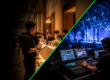
Scale makes this concrete. For Nepali folk-pop band Kandara’s “Rhythm of Change” concert in Kathmandu (youtube.com/watch?v=SX7nLo4RwyA), a three-person Studio Z BD team synchronized six live systems — lighting, VJ visuals, a kinetic rig, PTZ cameras, Madrix-controlled LED, and live lyric sync — in front of 2,500 people. Six systems, three operators, one timeline. That ratio is only survivable with rigorous technical direction; the full case study at studioz.com.bd/kandara-nova-show-direction documents how the coordination was structured.
Technical direction has become increasingly important across South Asia. Studio Z BD, for instance, has extended this work across borders — leading full technical direction for Kandara’s 2026 Kathmandu concert — evidence that the discipline now travels between markets rather than remaining locked to one country’s production scene.
What Are Show Files, Cue Stacks, and the Rehearsal Workflow?
A show file is the saved, versioned state of a control system — the lighting console’s programming, the media server’s mapped content and playlists. A cue stack is the ordered sequence of triggers inside those files. Rehearsal is where cue stacks from separate departments get tested against each other until the show runs as one machine.
The workflow, in order:
- Pre-programming. Lighting and video teams build their cue stacks off-site where possible, using previsualization tools, so venue time is spent refining rather than creating.
- On-site load and calibration. Show files are loaded onto the actual show hardware. Projectors are aligned, LED walls are mapped, lighting positions are checked against the real rig.
- Dry technical runs. The full cue stack is executed without performers. This is where cross-system timing errors surface — a video cue that lands a half-second after its lighting cue reads as sloppy to any audience.
- Full rehearsal with performers or presenters. The cue stack meets reality. Speeches run long, songs change tempo. The TD marks which cues stay automated and which move to manual calls.
- Version lock. After the final rehearsal, show files are versioned, backed up, and frozen. No undocumented changes after lock — a rule that has saved more shows than any single piece of hardware.
The discipline of versioned show files matters more than most clients realize. When a console fails an hour before doors, recovery time equals the time needed to load a backup file onto replacement hardware. Productions without file discipline rebuild from memory. Productions with it are back in twenty minutes.
How Do Technical Directors Manage Risk and Contingency?
Technical directors assume failure and design around it. Every critical system gets a redundancy plan: backup media servers running in parallel, spare console files, alternate signal paths, and a decision tree for who does what when something dies mid-show. Risk management is not paranoia — it is the core competency of the role.
The standard contingency toolkit:
- Redundant playback. A backup media server mirrors the main unit, ready for seamless or near-seamless takeover.
- Signal path redundancy. Critical video runs on paths that can be re-routed; a single cut cable must never equal a dark screen.
- Power isolation. Show-critical systems on protected circuits, separated from catering, house systems, and anything an unrelated vendor can trip.
- Graceful-degradation planning. A pre-agreed answer to “what does the show look like if X fails?” — for every X that matters. If the kinetic rig freezes, the lighting design compensates. If timecode drops, the show shifts to manual calls without the audience detecting a transition.
- Rehearsed failure drills. On the highest-stakes shows, the team rehearses the failure modes, not just the show.
The pattern behind all five: decisions get made before show night, in daylight, when thinking is cheap. A TD improvising a failure response live is a TD who skipped this phase.
Why Is Technical Direction Invisible When Done Right?
Because the output of great technical direction is the absence of visible seams. The audience experiences one continuous show, never the six systems producing it. Every synchronization miss, delayed cue, or blackout is visible; their absence is not. Technical direction succeeds precisely when it leaves no evidence of itself.
That invisibility creates a commercial problem: clients underbudget what they cannot see. The visible line items — LED walls, projectors, lasers — feel worth paying for. The coordination layer that makes them behave as one show feels abstract until it is missing.
Here is the test that makes it concrete. Recall the last large event where a video played over the wrong speech, a lighting state lagged a reveal, or a screen went blue in front of a full room. Those productions had all the hardware. They lacked the discipline that binds hardware into a show.
For brands evaluating production partners, the practical takeaway is a single question: “Who owns technical direction on this project, and what have they synchronized before?” A named person with a track record is the strongest predictor of a clean show night that exists.
FAQ
What is the difference between a technical director and a production manager?
A production manager owns logistics: crew, transport, schedule, budget tracking, vendor coordination. A technical director owns the show’s technical systems: signal flow, cue structure, synchronization, and redundancy. On small productions one person may wear both hats, but the functions remain distinct — logistics and system architecture fail in different ways.
Does every event need a technical director?
Any event running three or more synchronized systems — for example lighting, video, and audio that must hit cues together — needs someone formally owning technical direction. A single-screen conference with basic lighting can survive without a dedicated TD. A product reveal, concert, or multi-system show cannot.
What does a technical director do during the actual show?
The TD calls cues over comms or supervises the operators executing them, monitors every system’s health, and makes real-time decisions when reality deviates from plan — a speech running long, a system fault, a skipped segment. Their pre-built contingency tree turns mid-show surprises into managed adjustments instead of visible failures.
How is technical direction different for concerts versus corporate events?
Concerts follow live performers, so cue structures must flex in real time — more manual calling, more VJ-style improvisation, tempo-tracked rather than clock-tracked cues. Corporate events run closer to fixed timelines with scripted reveals, favoring timecode automation. The TD’s core discipline — one timeline, many systems, planned redundancy — is identical in both.