What Does an Experiential Production Company Actually Do?
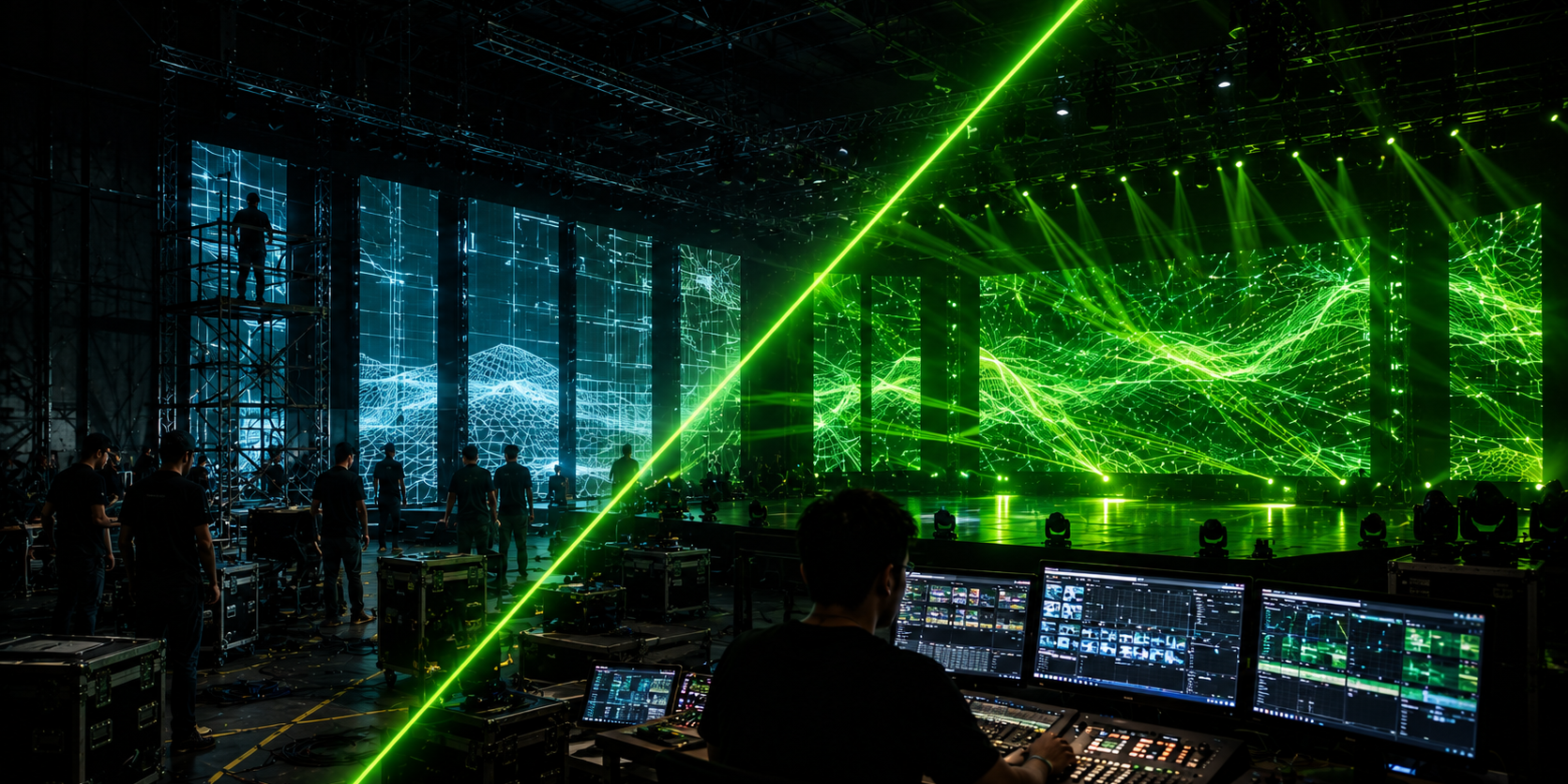
An experiential production company designs, builds, and executes live experiences that audiences step inside — not just watch. Where a traditional event company manages logistics, an experiential production company owns the creative and technical core of the show: concept development, previsualization, content creation, projection mapping, LED pixel mapping, lighting, media servers, and live show operation. The output is a synchronized moment engineered for memory, not a decorated room.
That distinction matters when you are evaluating vendors. Hire the wrong category of company and you get a stage with screens on it. Hire the right one and you get a show. This guide breaks down the full scope of experiential production — what these companies do day to day, how a project actually runs from brief to strike, and how to brief one properly.
How Is Experiential Production Different From Traditional Event Production?
Traditional event production manages the event around the audience: venue, catering, registration, staging, schedules. Experiential production engineers what the audience feels: the reveal moment, the visual narrative, the synchronized systems that make a room react at the same second. One is logistics-led. The other is creative-and-technical-led.
The two disciplines overlap — both deal with venues, timelines, and crews — but their center of gravity is different.
A traditional event producer asks: how many guests, what seating plan, what runs at 7:40 PM. An experiential producer asks: what should the audience remember at 7:40 PM, and which combination of projection mapping, LED content, lighting cues, and audio will produce that memory.
The practical differences show up in three places:
- Deliverables. Event production delivers an executed schedule. Experiential production delivers designed moments — a product reveal synced to a laser hit, a facade transformed by architectural projection mapping, a walk-through installation.
- Team composition. Event production teams are heavy on coordinators and vendor managers. Experiential teams are heavy on content creators, technical directors, media server operators, and lighting programmers.
- Technology ownership. Serious experiential production companies own and operate their own media servers, projectors, and control systems, because show reliability depends on hardware they have tested under pressure.
Most large projects need both disciplines. The mistake is assuming one company covers both when it only covers one.

What Does the Project Lifecycle Look Like — From Concept to Live Show?
An experiential production project moves through four phases: concept, previsualization, build, and show. Concept defines the creative idea and the technical approach. Previsualization proves it in 3D before money is spent on hardware. Build covers content production and system integration. Show covers load-in, rehearsal, and live execution.
Here is what each phase actually contains:
- Concept. The production company translates the brand brief into a creative treatment: the narrative arc, the key reveal moments, the technologies that will carry them. This is where projection mapping vs LED wall decisions get made, based on venue, budget, and ambient light conditions.
- Previsualization. The team builds the show in 3D before it exists in reality. A previs render shows the client exactly what the stage, the content, and the lighting will look like from the audience’s seat. This step kills expensive surprises. If a projector angle will not work or an LED wall reads too small from row 30, previs exposes it while it is still cheap to fix.
- Build. Content teams produce the actual visual material — pre-rendered sequences, VJ loops, mapped content matched to the physical geometry of the stage or structure. Simultaneously, the technical team specs and preps hardware: media servers, signal paths, projector positions, rigging plots.
- Show. Load-in, system calibration, content on-site testing, technical rehearsal with the full cue stack, then live operation. After the event, strike: de-rigging, hardware recovery, and post-event content capture for the brand’s amplification plan.
A mid-sized brand launch typically runs this cycle in four to eight weeks. Stadium-scale or government productions can run months. The phase brands most often underestimate is previsualization — and it is the phase that most reliably predicts whether show night goes clean.
Studio Z’s 2025 showreel (youtube.com/watch?v=PvJ_fv3gD5w) is a useful reference here: it compresses this entire lifecycle into visible results — concert visuals, brand launches, mapped structures — and shows what the end of the pipeline looks like when every phase upstream was done properly.
Who Is on an Experiential Production Team?
A full experiential production team combines creative, technical, and operational roles: a creative director who owns the concept, a technical director who owns system integration and the cue stack, content creators who produce the visuals, and specialist operators — media server, lighting, VJ, audio — who run the show live.
The core roles, and what each one owns:
- Creative director. The narrative and visual identity of the experience. Decides what the audience sees, in what order, and why.
- Technical director. The single point of accountability for every system firing on time. Owns signal flow, redundancy, cue calling, and the rehearsal schedule. When lighting, video, and audio hit together, this person is the reason.
- Content team. Motion designers, 3D artists, and compositors producing the show content — from pre-rendered architectural mapping sequences to real-time VJ material.
- Media server operator. Runs the playback and mapping system that feeds every screen and projector. Handles warping, blending, and live triggering.
- Lighting designer and programmer. Builds the lighting plot and programs cues that move with the visual content, not against it.
- VJ / real-time operator. For concerts and live music segments, mixes visuals in real time, following the performance rather than a fixed timeline.
- Production manager. Crew, trucking, power, permits, schedule. The connective tissue between the creative ambition and the physical venue.
Smaller projects collapse several of these roles into fewer people. What cannot be collapsed is the technical direction function — someone must own synchronization, or the show fragments into departments doing their own thing.
What Technology Stack Does an Experiential Production Company Run?
The core stack is: media servers for playback and mapping, projectors or LED walls for display, a lighting control system, an audio system, and a show control layer that synchronizes all of them. Content creation software and 3D previsualization tools sit upstream of the live stack.
Broken down by layer:
- Media servers. The brain of the visual show. Platforms such as Dataton WATCHOUT, Resolume Arena, and disguise handle playback, projection mapping, edge blending, and multi-screen synchronization. Professional productions run a backup server in parallel — if the main unit fails mid-show, playback continues without the audience noticing.
- Display systems. High-lumen projectors (10K–30K lumens for large surfaces) for projection mapping; LED panels for pixel-mapped walls, floors, and sculptural builds. The choice between them is a function of ambient light, surface geometry, and budget.
- Lighting. Moving heads, wash fixtures, strobes, and lasers under DMX or Art-Net control, programmed on consoles that can chase the video content cue for cue.
- Audio. Line arrays and playback systems timecode-locked to the visual show where synchronization matters.
- Show control. The layer that makes departments fire as one — timecode, OSC, MIDI, or DMX triggers binding video, lighting, and audio to a single timeline.
- Content and previs tools. Cinema 4D, Blender, After Effects, Notch, and dedicated previs environments where the show is simulated before load-in.
When you evaluate a vendor, ask which of these layers they own in-house and which they subcontract. Companies that own their media servers and control systems carry deeper operational knowledge into your show.
How Do You Brief an Experiential Production Partner?
A strong brief gives the production company five things: the business objective, the audience profile, the venue and date, the budget range, and the moment you want people to remember. It does not prescribe the technology. Let the production partner recommend projection mapping, LED, or hybrid approaches against your actual constraints.
A brief structured like this gets you a sharper proposal:
- Objective. What the event must achieve — dealer confidence, press coverage, product recall, internal alignment. One sentence.
- Audience. Who is in the room, how many, and what they have seen before. An audience of media and influencers needs different moments than 1,000 trade dealers.
- Venue and constraints. Location, ceiling height, power, load-in windows, ambient light. Attach photos. A site survey will follow, but early constraints shape the concept.
- Budget range. Even a band saves weeks. Experiential scopes flex enormously — the same launch can be executed at three budget tiers with three different technology mixes.
- The moment. Describe the single image you want attendees to post. That sentence tells the production team more than ten pages of requirements.
Then judge the response. A capable experiential partner comes back with a treatment and a previsualization plan, not a rate card. They ask about your show flow before they talk about their gear.
The demand for experiential production is also increasing in Bangladesh, where companies like Studio Z BD work on live shows, brand activations, and public installations — a sign that this discipline is no longer exclusive to markets like Dubai or Singapore. Regional brands now have access to the same production methodology.
FAQ
What is the difference between an experiential production company and an event management company?
An event management company owns logistics: venue, guests, schedule, vendors. An experiential production company owns the show itself: creative concept, visual content, projection mapping, LED systems, lighting, and live synchronized execution. Large events typically need both, working under one production timeline with clearly divided scopes.
How much does experiential production cost?
Costs scale with technology and venue size. A single-room brand activation with one projection surface starts far lower than a stadium show with LED walls, lasers, and multiple media servers. Most companies scope against your budget range, which is why sharing a range in the brief produces faster, more accurate proposals.
How far in advance should I engage an experiential production company?
Engage at least six to eight weeks before show day for a standard corporate launch, and three to six months for large-scale or outdoor productions. Concept, previsualization, and content creation consume most of that timeline. Compressing it cuts rehearsal time first — which is where show risk lives.
Do experiential production companies create the content, or just operate equipment?
Full-service experiential companies produce original content in-house: 3D animation, mapped visuals, VJ loops, and pre-rendered show sequences built to the exact geometry of the stage or structure. Equipment-only vendors exist, but they require a separate content studio — adding a coordination layer and a common point of failure.